Digital Self-Identity
When I was in college searching for marketing internships, I used my LinkedIn profile to emphasize my experience in marketing and digital work. When I was applying to public media jobs, I adjusted my profile to highlight my passion for using media to bring educational resources to all communities. Then, when I decided to transition to academia, I updated my profile to better showcase my research experience. None of these updates were lies, or even stretched truths. They were just the different parts of me, performed for different audiences at different times.
In Digital Performance in Everyday Life (2021, p. 28), Gratch and Gratch refer to James Carey’s Ritual Model of Communication, which posits that communication reinforces social order, which in turn maintains society and social structures. They explain how the model reframes our digital communication as maintaining the status quo through its forwarding of social norms. What struck me most was the following line that explained how technological affordances can fit into Carey’s model: “Performances of identity in virtual spaces often align with the norms and expectations of the spaces in which they occur. In doing so, users articulate self-identity, and the self is positioned in relation to others via the constraints, possibilities, and norms of the site” (p. 28). I often draw from Evans et al. (2017) to understand affordances as relational structures that present possibilities for action. In other words, the relationship between oneself and a platform’s technological capabilities define what we are able to do on said platform. As somewhat of a post-positivist, I tend to think of affordances as something to be measured and tested. Now, using Carey’s model I see how affordances have a quite overt role in upholding power structures via platforms, as they compel us to do certain things on a platform. In defining what we can do, affordances also define what we cannot do.
Let’s return to LinkedIn. While I could hypothetically go on LinkedIn and write a post or update my bio to discuss how much I love watching Vanderpump Rules in my free time, I don’t do that, because the categories of my life LinkedIn wants me to share on my profile are clear from its predetermined and preordered headers, including Experience at the top, then Education, Skills, Courses, and so on. There is an “Interests” category, but users must choose a Top Voice, Company, Group, Newsletter, or School with an existing LinkedIn page. I could include the company Bravo TV in my “Interests” (I checked), but I have a feeling after reading my LinkedIn profile that people would think that “Interest” refers to Bravo’s media business, rather than their reality stars. Through its affordances, LinkedIn defines and upholds normal and acceptable performances of self in the professional world. Reality television-watching habits are not that.
LinkedIn thus demonstrates how affordances compel us into performing the most “professional” versions of ourselves. In the past, I’ve worried that I was choosing to lean in (pun intended) to an inauthentic version of myself on LinkedIn. I even did a project in one of my college classes where I surveyed fellow students to highlight how using LinkedIn was harmful to students’ mental health. And yet! There I was (am!?), updating my profile then endlessly scrolling to see who got the internship, the job, the promotion, the award, the journal article, the conference presentation, the Ph.D. acceptance. Then, I perform accordingly: tailoring my statement of research interest in my bio, adding conferences and awards, engaging with posts from others in my field… the list goes on. Evoking Carey, this can be understood as reinforcing social order through my communication on LinkedIn. I see what the norm is on LinkedIn, then do the same. My LinkedIn also doesn’t do much of anything to push back against social structures. I always “like” posts in which people highlight their “failures” (e.g., job or conference rejections), or posts that call out some inequity in an industry (e.g., unethically low salaries), but that’s it.
I talk a big talk about resisting power structures, yet I open LinkedIn, feel the pressure to conform, perform the version of myself (Productive! Intelligent! Accomplished!) that I want professors, peers, and recruiters to see, and in doing so, contribute to that same pressure that molds others into the status quo of a competitive, work-obsessed, hypercapitalistic society.
If you want some examples of what I’m talking about, be sure to check out my LinkedIn! (See what I did there?)
References
Evans, S. K., Pearce, K. E., Vitak, J., Treem, J. W. (2017). Explicating affordances: A conceptual framework for understanding affordances in communication research, Journal of Computer-Mediated Communication, 22(1), 35–52, https://doi.org/10.1111/jcc4.12180
Gratch, L. M., & Gratch, A. (2021). Digital performance in everyday life (1st ed.). Routledge. https://doi.org/10.4324/9780429439872
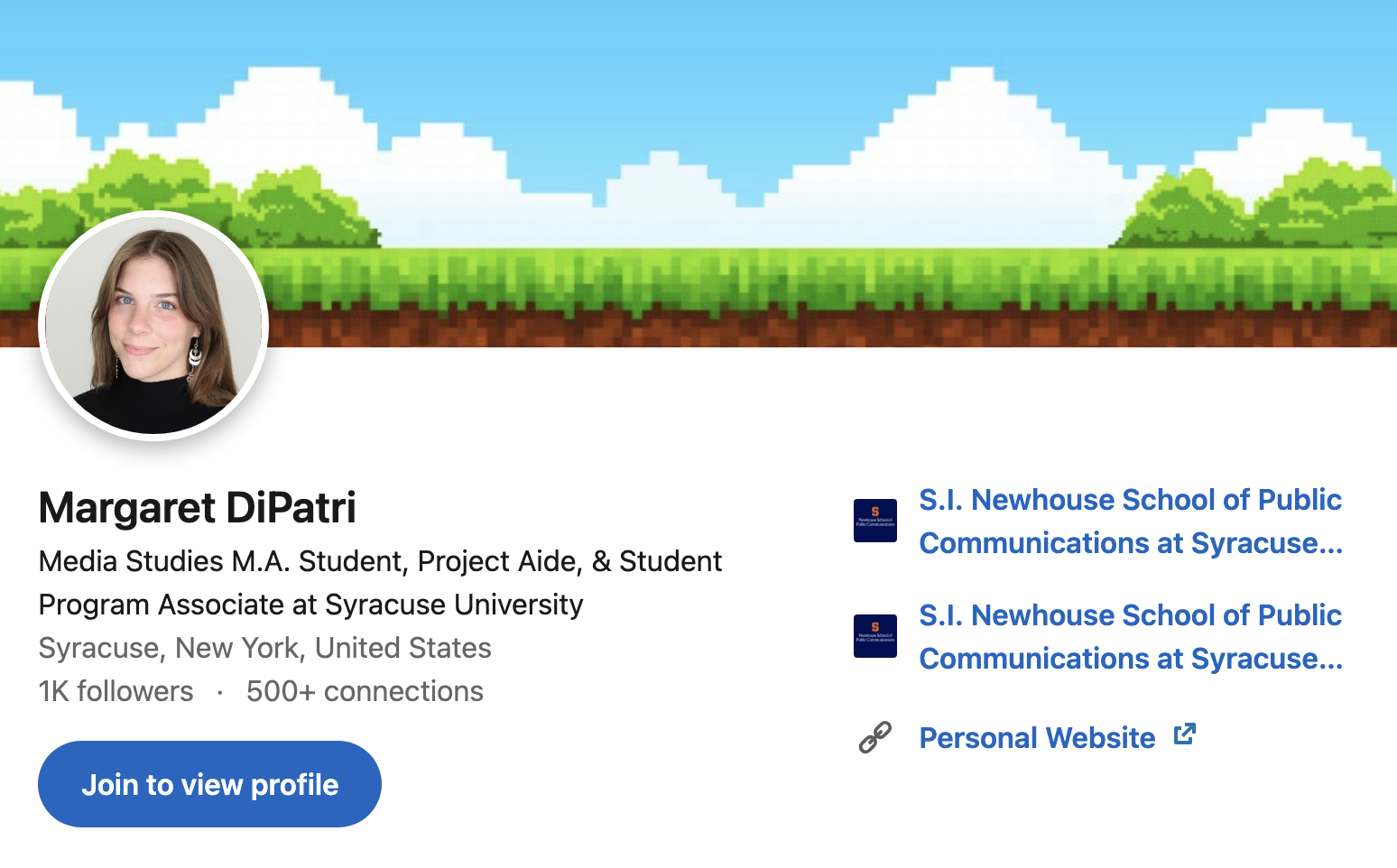
A screenshot of Maggie’s LinkedIn page as visible to an outside viewer.
